The short version
- FINMA recommends that banks, insurers and other supervised institutions have a PQC roadmap by mid-2027 at the latest. It is a recommendation, not an obligation.
- Only 8 percent of the institutions surveyed have a concrete roadmap.
- The first step is not choosing a new algorithm. It is an inventory: where is which cryptography?
Ask around your organisation where RSA or elliptic curves are in use. The honest answer is almost always: we do not know exactly. That is where post-quantum cryptography begins — not with the choice of a new algorithm.
Between November 2025 and January 2026, FINMA surveyed sixty institutions. 8 percent have a concrete roadmap for quantum-safe encryption; 72 percent have not yet planned or taken any measures. This post shows how to get from the second group into the first, in five steps.
What post-quantum cryptography is
Almost every encrypted connection, every digital signature and every key exchange today rests on methods like RSA or elliptic curves. Their security relies on mathematical problems that are practically unsolvable for today’s computers. A sufficiently powerful quantum computer could solve them.
Post-quantum cryptography, PQC for short, means methods that withstand such a machine. They run on today’s hardware; no quantum computer is needed for them. In 2024 the US standards institute NIST published the first three standards: FIPS 203, 204 and 205, known as ML-KEM, ML-DSA and SLH-DSA.
Which of today’s methods are affected, FINMA names by example in its guidance: RSA, ECDSA, EdDSA, DH and EC-DH. These are not exotic. They are the foundation of TLS, VPN, certificates and signatures in practically every institution.
Why now, although the quantum computer does not exist yet
There are two reasons.
First, the migration takes years. Cryptography sits in applications, network devices, hardware security modules, libraries, and in your service providers’ systems. Much of it can only be replaced in the regular release cycle.
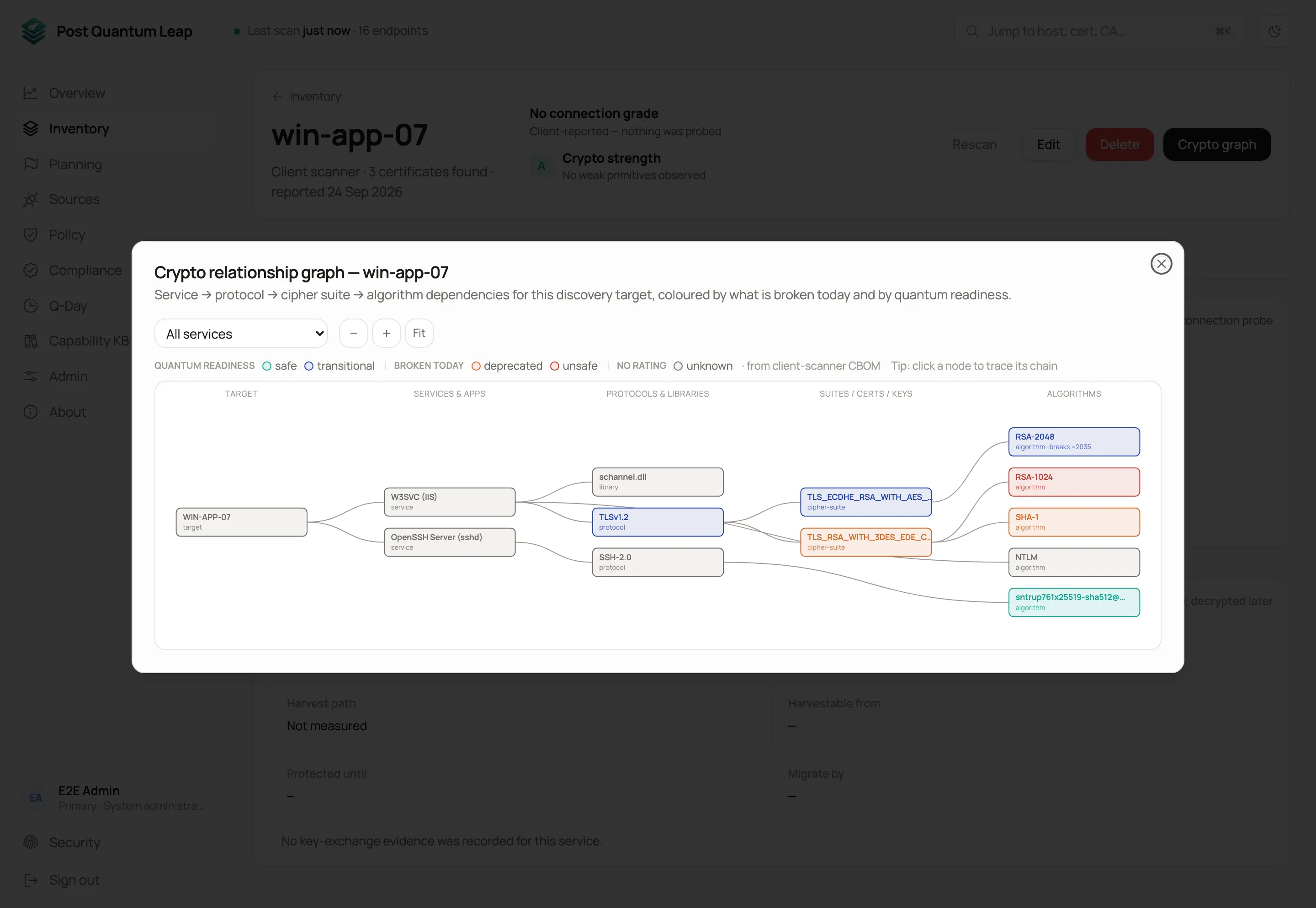 Where cryptography hides: one service, its protocols, cipher suites and algorithms — every node rated for quantum safety. (Screenshot from Post Quantum Leap)
Second, some data must stay confidential longer than today’s encryption holds. Whoever intercepts encrypted traffic today can store it and decrypt it later. The field calls this “harvest now, decrypt later”, and FINMA mentions the risk explicitly. We will devote a post of its own to it.
And how do the institutions judge the situation themselves? Around two thirds expect that within ten years a quantum computer will break RSA-2048 in 24 hours. Whether that is right, nobody knows. But if you have to protect data for ten years, you should not bet on it taking longer.
What FINMA recommends, and what it does not
In July 2026 FINMA published Guidance 05/2026, “Quantum Computing”. The key sentence: FINMA recommends drawing up a PQC roadmap by mid-2027 at the latest.
Two points matter here. First, it is a recommendation. The guidance is not a circular, and Switzerland has no binding post-quantum mandate. Second, mid-2027 is about a roadmap, not a completed migration.
At the same time, FINMA announces it will give the topic more weight in its ongoing supervision. The question of where your institution stands will come. A recommendation does not mean it does not matter.
Five steps to the roadmap
In chapter 3, the guidance describes what a sound basis for the migration looks like. Five steps follow from it.
1. A strategy the board carries
FINMA recommends that the work rest on a strategy approved by the governing body. It need not be a document of its own: the PQC strategy can be part of an existing one, for instance on cyber risk. What matters is the backing of the board. Without budget and priority, every roadmap stays paper.
2. The cryptographic inventory
Here the real work begins. FINMA describes a comprehensive inventory of all cryptographic methods: encryption in transit — VPN, TLS, HTTPS — data at rest, digital signatures, key management and authentication. Explicitly included are systems that are outsourced or bought as a service.
The inventory shows which algorithms are quantum-vulnerable. Without this overview nothing can be prioritised and no effort estimated. 76 percent of the institutions surveyed see high or very high value in such an inventory.
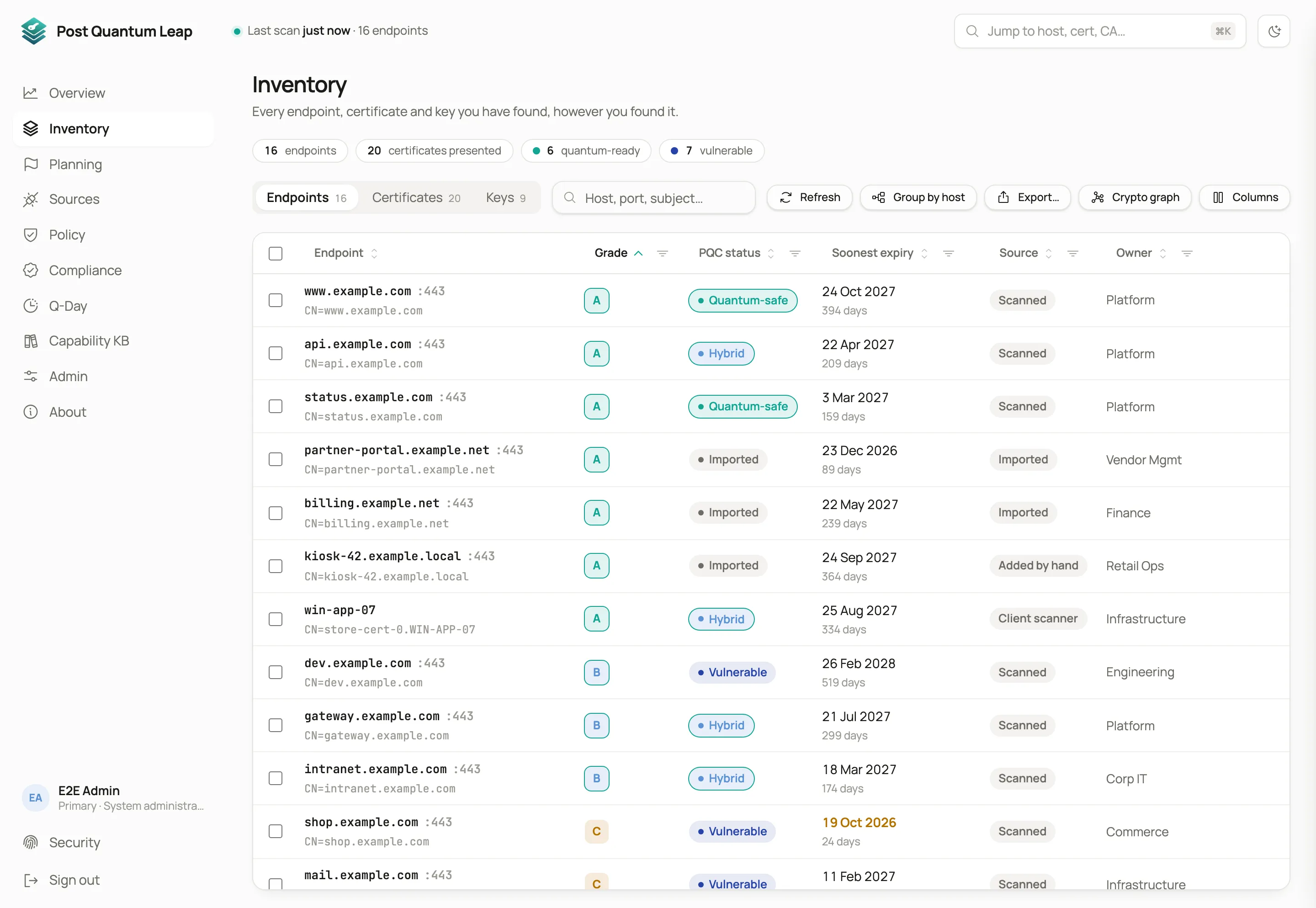 What the result looks like: every system with a grade, a post-quantum status and an owner. (Screenshot from Post Quantum Leap)
3. How long the data must stay protected
Not every connection is equally urgent. FINMA recommends assessing the protection needs of critical data: how long must confidentiality and integrity be guaranteed? For electronic signatures, non-repudiation comes on top. Data that must stay protected for the long term belongs at the top of the list.
4. Priorities and target dates
From the inventory and the protection needs comes the implementation plan, with milestones and priorities. FINMA considers it advisable to set target dates: one for migrating the critical business processes, one for the full migration. That turns an intention into a plan progress can be measured against.
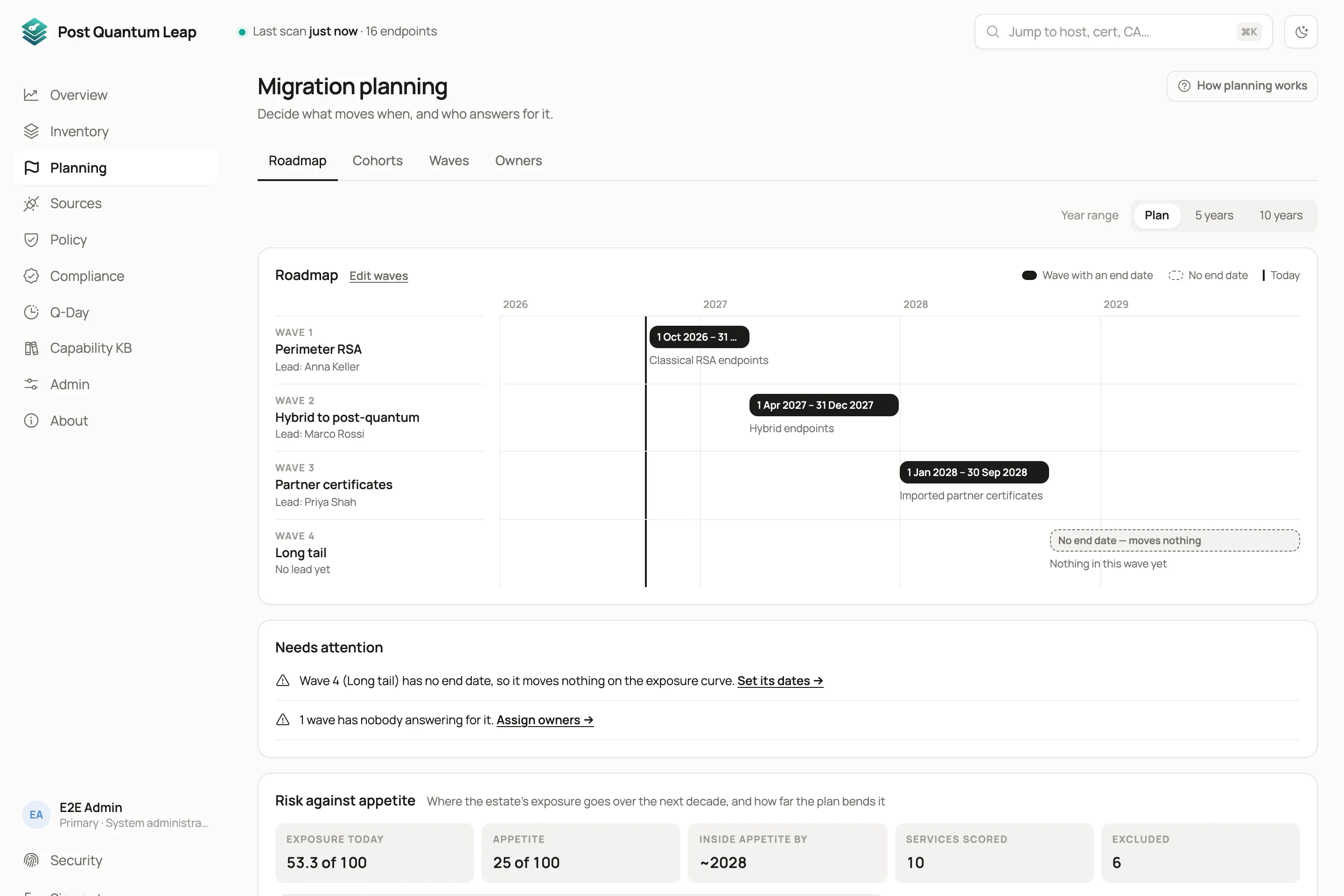 From inventory to plan: milestones with target dates, progress measured against them. (Screenshot from Post Quantum Leap)
5. Crypto-agility and service providers
The migration is not a one-off project. FINMA recommends making crypto-agility a requirement for new systems and applications: algorithms should be replaceable without rebuilding the architecture. And because a large part of the cryptography sits with service providers, they belong at the table. Responsibility for outsourced functions stays with the institution. 60 percent of the institutions surveyed are already talking to their software vendors.
Four mistakes you can avoid
Starting with the algorithm. Whether ML-KEM or a hybrid scheme is an important question, but not the first one. First you have to know where what is in use.
Copying the inventory from the CMDB. A CMDB shows what is documented. A scan shows what actually answers on the network. With cryptography, the two are often far apart.
Taking inventory once and ticking it off. Certificates expire, systems arrive, providers change. FINMA speaks of a continuously maintained inventory that reflects the current state.
Forgetting the service providers. Core banking, payments, cloud services: a large part of the cryptography is not in your own hands. Ask early about your vendors’ plans.
Conclusion: inventory first
Less than nine months remain until mid-2027. Whoever starts now has time for a considered roadmap instead of a rushed one. The first step is not choosing an algorithm; it is the answer to the question from the beginning: where in your organisation is which cryptography?
Post Quantum Leap answers exactly that question. The software builds the inventory with read-only scans, grades every system, and derives the prioritised plan from it. It can run entirely in your own infrastructure, air-gapped if you wish.
Next step: download the one-page summary of FINMA Guidance 05/2026, or see Post Quantum Leap live in 30 to 45 minutes.